The Tommore Burn smolt trap will be familiar to Spey followers. The Tommore Burn is a lower tributary of the River Avon (A’an), which it joins a short distance upstream of the Delnashaugh Hotel. This burn has an impassable culvert under the Glenlivet Road so it has been stocked since 2012 with salmon from our hatchery. From 2013 the stocked 0+ parr have been fin-clipped to aid identification and since 2015 the Tommore trap has been operated to count the smolts emigrating in the spring. In addition we have completed a number of electrofishing surveys each summer to assess the parr population. The video below shows the trap on a snowy spring morning.
DSCF6517 from Spey Foundation on Vimeo.
In the summer of 2017 the parr population in the sample sites was approximately double the density seen in previous years so an increased smolt production was anticipated in 2018.
The graphs below shows the Tommore trap salmon smolt count to date, the upper graph showing water level and the lower the water temperature.
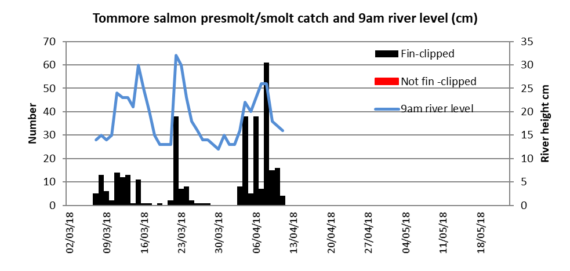
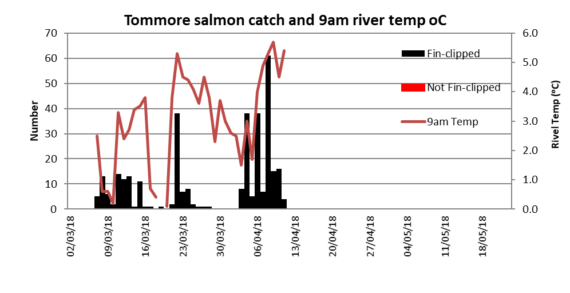
There has been no shortage of water so far this spring, mainly from snow melt on Ben Rinnes, although the snow pack there is running out. At the same time the water temperatures have been low, a consequence of the long drawn out winter. The total catch of salmon smolts so far this year is 332, although they have been mainly presmolts. This compares with 234 at the same date in 2015, the year with the highest total so far (382). It has been cooler this year, the mean temperature over equivalent periods being 3.7oC in 2018 and 4.55oC in 2015. Trap operation commenced at an earlier date this year but the count is still ahead of 2015 on a like for like basis.
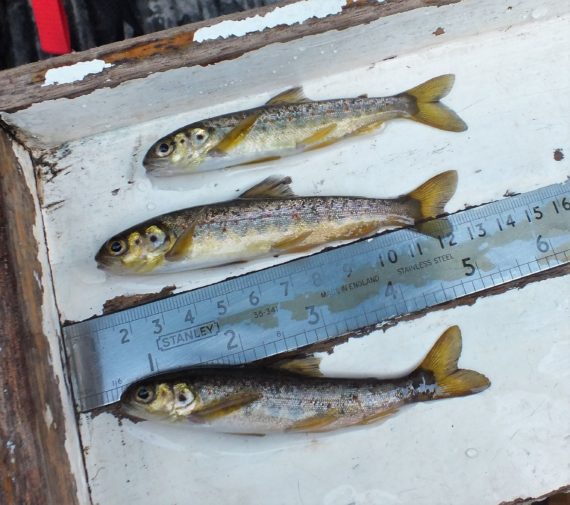
Assuming there is some rainfall in the next week or two the 2018 smolt count from the Tommore is on schedule to be the highest to date but each year is different. One finding from the Tommore Burn research has been that the smolts leave the Tommore much earlier than they start to move in the larger tributaries, this may be in response to the greater need to migrate when there is water in the small burns.
The broodstock for the Tommore Burn fish were taken from the Avon mainstem, mainly in 2015, although there appears to be an increased proportion of larger, three year old smolts this year. We don’t know where these fish would ultimately have spawned if they had been left to their own devices but it is unlikely they were all destined to spawn in small burns. If that is the case, this early emigration behaviour observed may be an instinctive trait.
It is interesting to reflect on the potential contribution of the Tommore Burn to the Spey. If 500 smolts emigrate from the Tommore Burn this year, and they all survive to reach the sea, the maximum number of returning fish that could be expected is 25 (at 5% marine survival). This may produce a rod catch of 4 fish (15% exploitation). This is less than 0.08% of the relatively poor Spey salmon catch in 2017.
Another way of assessing the Tommore Burn is to look at the number of broodstock used. The Tommore smolts are mainly 2 year olds, therefore the 2018 smolt run is from the 2016 stocking/2015 broodstock. In 2015 13 hens were taken from the Avon and 58% of the resulting 0+ parr were stocked in the Tommore. This equates to 8 hens and 8 cock salmon, 16 in total therefore contributing to the Tommore stocking. There are a lot of assumptions made here but the number of returning adults could be higher than the number of broodstock used (25 compared to 16). This is not the massive multiplier effect that may be expected, in fact it looks quite modest. Such modest gains have to be considered against the negative impacts arising from stocking (see CNL_17_40_KyleYoung).
Further updates on the Tommore Burn will be provided as the season progresses. More frequent updates are made on the Spey Fishery Board Facebook page.